
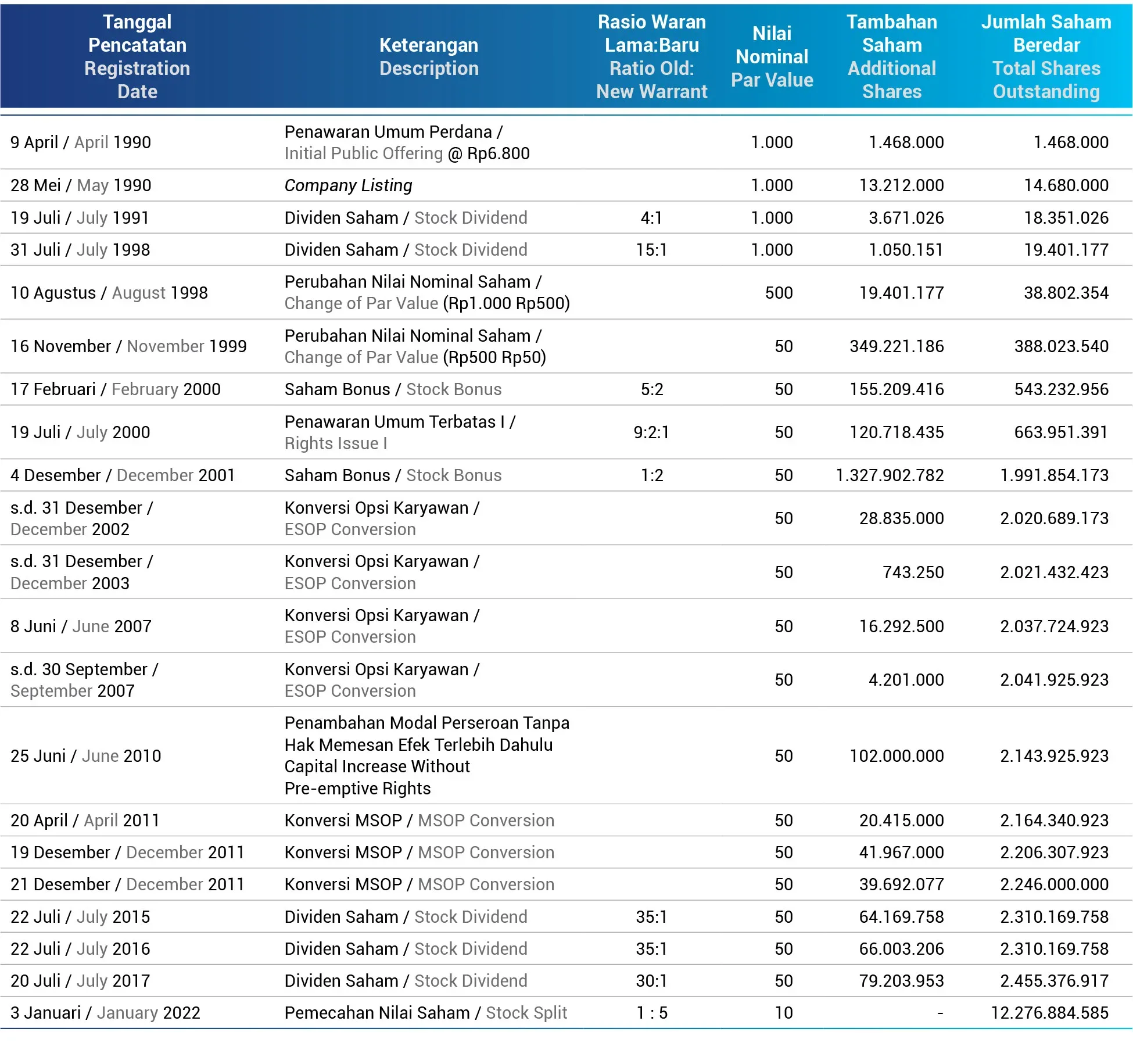
Chronological Stock Listing
The development of the Company's shares since the initial public offering on the Jakarta and Surabaya Stock Exchanges (now the Indonesia Stock Exchange) on 14 February 1990 is presented below.
Investor Relations
Find financial reports, stock information, ESG updates, and the latest news for PT Metrodata Electronics Tbk (IDX: MTDL).
PT Metrodata Electronics Tbk (the “Company”) is a public company listed on the Indonesia Stock Exchange since 1990 (IDX: MTDL), and is a leading digital solutions provider and technology innovator in Indonesia.
For nearly five decades, the Company has partnered with world-class information and communication technology and digital companies. The Company continues to allocate its resources to seek, develop, and deliver new and promising innovative businesses, accelerating digital transformation and Industry 4.0 in Indonesia.
The Company is the only listed national ICT company to receive prestigious awards: The Best 50 Public Listed Companies 2021 from Forbes Indonesia Magazine, Best Listed Companies 2021 from Investor Magazine, and Best Issuer in the Hardware & Technology Equipment Sector from Bisnis Indonesia Magazine in 2021.
As a public company, the Company recognizes its responsibility to all shareholders. We ensure that all shareholders, including minority shareholders, receive relevant company information, stay informed of material developments, and receive consistent dividends.
Notary Office of Christina Dwi Utami
Jl. K. H. Zainul Arifin No. 2
Komp. Ketapang Indah Blok B2 No. 4-5
Jakarta 11140
Tel. (62-21) 630 1511
Fax. (62-21) 633 0711
Public Accounting Firm Rintis, Jumadi, Rianto & Rekan
WTC 3
Jl. Jend. Sudirman Kav. 29-31
Jakarta 12920
Tel. (62-21) 50992901 / 3112901
Fax. (62-21) 52905555 / 520905050
PT Datindo Entrycom
Jl. Hayam Wuruk No. 28
Jakarta 10120
Tel. (62-21) 350 8077
Fax. (62-21) 350 8078
For any investor relations inquiries, please email:
investor.relation@metrodata.co.id
or visit our contact page below.
The Company strives to deliver maximum value to Shareholders.
The development of the Company's shares since the initial public offering on the Jakarta and Surabaya Stock Exchanges (now the Indonesia Stock Exchange) on 14 February 1990 is presented below.
Loading
As a public company, the implementation of Good Corporate Governance is a must, in order to provide a foundation for the Company's operational activities. PT Metrodata Electronics Tbk applies GCG principles consistently and strengthens systems and procedures as practices evolve.
Transparency is a commitment to ensuring the availability of material information to stakeholders. This may include the Company's financial position, management, and ownership structure, made available in an accurate, clear, and timely manner.
Accountability ensures the presence of mechanisms, roles, and responsibilities needed for professional management upon all decisions and policies that affect the Company's operational activities.
Responsibility provides a clear explanation of the roles of each party in achieving common goals, and ensures that relevant regulations and social norms are adhered to.
Fairness ensures that decisions and policies are aligned with stakeholder interests, including customers, vendors, shareholders, investors, and the general public.
The General Meeting of Shareholders (GMS) is the highest organ within the governance structure of PT Metrodata Electronics Tbk. The GMS has authority to determine the Company's long-term direction and to appoint and dismiss members of the Board of Commissioners and Directors.
Read more
Shareholder resolutions may be reached by deliberation for consensus. If consensus is not reached, decisions are made by voting when affirmative votes exceed one half of the votes legally cast at the GMS, unless the Articles of Association provide otherwise.
In 2022 the Company held one GMS, the Annual GMS (AGMS) on 2 June 2022. Representatives holding 88.406% of issued shares attended. The AGMS approved the 2021 annual report (including release and discharge of the Boards), 2021 net profit allocation and cash dividend, appointment of the public accountant for fiscal year 2022, and commissioner and director remuneration.
Follow-up actions required outside the meeting for 2022 AGMS resolutions were fully implemented by Management in that year. Prior 2021 AGMS and EGMS resolutions were fully implemented in 2021. PT Datindo Entrycom, an independent party, tallied votes for the 2022 AGMS.
The Board of Commissioners oversees and advises the Board of Directors, ensuring the Company is managed in accordance with good corporate governance, applicable regulations, and the interests of shareholders. It also supervises strategic policies, business performance, and risk management while supporting the Company's long-term sustainability.
Read more
The Board comprises a President Commissioner, Vice President Commissioner, and Independent Commissioner, appointed for five years based on AGMS resolutions dated 26 June 2020. Members meet integrity and competence requirements and participate in internal training in management, business, and finance.
The Independent Commissioner is from outside the Company, holds no direct or indirect shares, and has no related-party ties with the Company, other commissioners, Directors, or major shareholders. Board size and composition consider business conditions and diversity of expertise.
The Board supervises management policies, approves the annual work plan before each financial year, reviews and signs the annual report, and may establish the Audit Committee, Nomination and Remuneration Committee, and other committees as needed.
Members follow the Board of Commissioners charter and code of conduct, avoid conflicts of interest, and limit concurrent positions at other public companies. The Board accounts to shareholders at the GMS. Performance and remuneration are evaluated based on supervision of operational and financial performance.
The Nomination and Remuneration Committee supports the Board of Commissioners in overseeing succession planning, leadership appointments, and remuneration policies. The Committee ensures that governance practices promote transparency, fairness, competitiveness, and long-term organizational performance.
Read more
Remuneration guidelines align packages with responsibilities, competence, and market benchmarks while supporting retention of key talent. The Board acting as nomination and remuneration committee determines director salaries and facilities as authorized by the GMS.
The Company currently does not operate a performance-based long-term compensation program for management and employees, considering business performance and market conditions.
The Board of Directors is responsible for managing the Company's operations and executing its business strategy in accordance with the Articles of Association and applicable regulations. The Board drives sustainable growth, delivers long-term value to stakeholders, and upholds the principles of good corporate governance.
Read more
Directors prepare the annual work plan and budget for Board of Commissioners approval before each financial year, execute resolutions of the GMS and Board of Commissioners, and comply with laws, GCG principles, and the Articles of Association.
Directors follow a code of conduct, manage conflicts of interest, and limit concurrent positions at other public companies. They account to the GMS through the annual report and are evaluated on operational and financial targets.
The President Director is supported by internal audit, legal, corporate secretary, and human resources functions to run day-to-day operations across the Metrodata Group.
The Audit Committee assists the Board of Commissioners in supervisory duties to enhance Good Corporate Governance. It comprises three members chaired by the Independent Commissioner.
Read more
The Committee evaluates management reports, compliance with laws and internal policies, fairness of financial statements, and the internal control system pursuant to capital market regulations.
Members maintain independence, meet at least quarterly, coordinate with Internal Audit and the external auditor, and review related-party transactions and risk exposures as needed.
The Board of Commissioners evaluates Audit Committee performance annually, including effectiveness of oversight over operations and financial matters.
The Corporate Secretary ensures compliance with capital market regulations and supports disclosure, investor relations, and GMS and Board proceedings.
Read more
Duties include maintaining corporate and securities records, facilitating information access for regulators and shareholders, and documenting meetings of the GMS, Board of Commissioners, and Directors.
The Corporate Secretary participates in training on governance and capital market rules and coordinates timely submission of required reports and announcements.
Internal Audit reports administratively to the President Director and functionally to the Audit Committee. Its scope covers compliance, risk management, control, and governance across operations.
Read more
The internal control system follows international standards including COSO and Indonesian regulations. Management and Internal Audit review adequacy and effectiveness annually.
Controls safeguard assets, ensure reliable financial reporting, and promote operational efficiency. Findings are tracked until remediated.
Robust risk management addresses business risks from internal and external factors and supports performance targets and comprehensive Good Corporate Governance.
Read more
The Company identifies risks by impact on business activities and finance to keep operations effective and reliable. Mitigation is integrated with strategic planning.
Risk of business competition: tougher competition in ICT distribution may affect market share and revenue if services and coverage do not keep pace with customer needs.
Risk of limited ICT human resources in Indonesia: failure to retain or recruit competent talent, or to keep skills current, may affect performance and product relevance.
Risk of foreign exchange rate fluctuations: principal pricing linked to foreign currencies may reduce demand when exchange rates move adversely.
Risk of information technology systems: malfunction, infrastructure failure, or cyber attacks on systems used across operations may disrupt business and harm reputation.